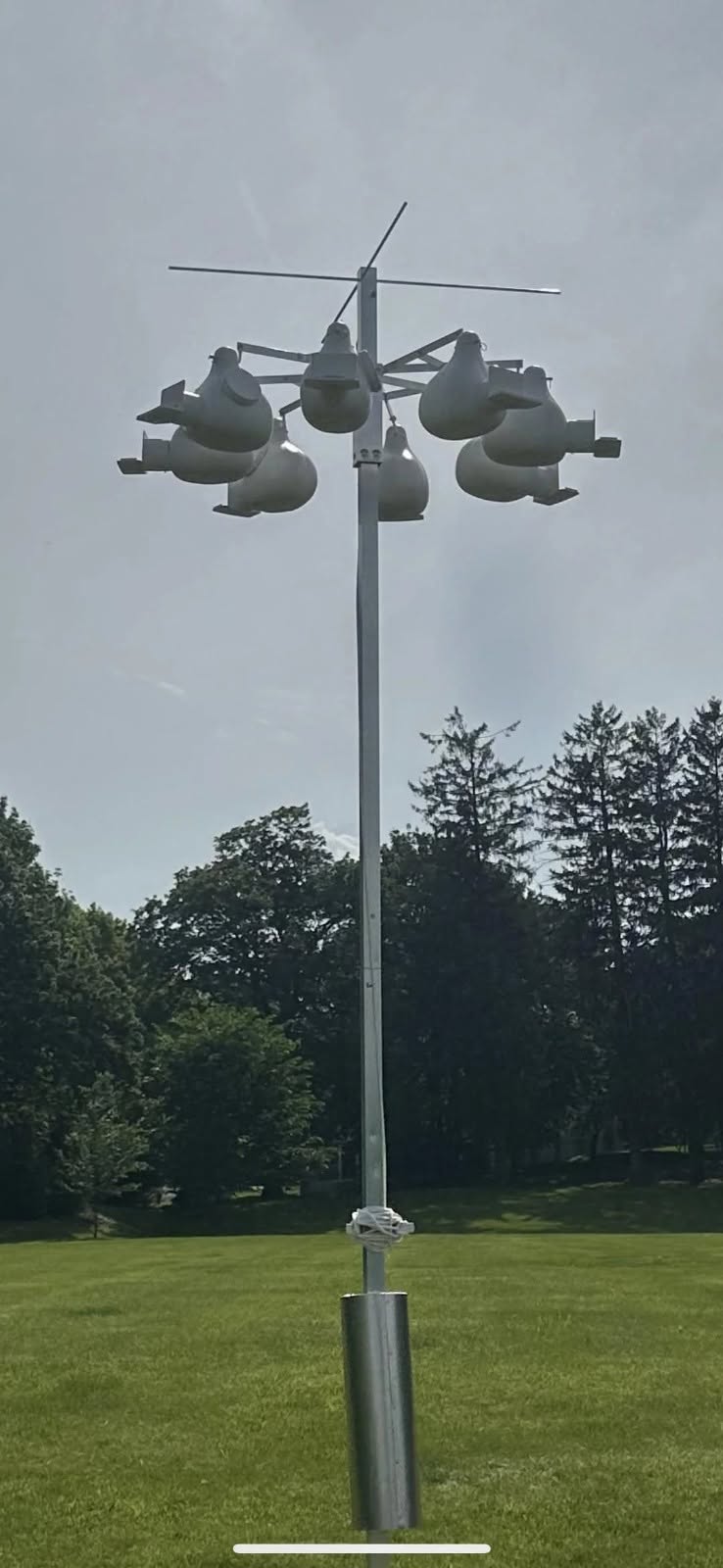
If you’ve recently taken a walk through your county park and spotted a tall pole dotted with what look like white surveillance pods or strange weather gear, you’re not alone in your curiosity.
Standing at over 12 feet high, these new additions to open fields may seem futuristic or even a bit out of place. The white, bulbous structures arranged in clusters might remind you of security cameras, satellite dishes, or modern art installations.
But these hanging structures aren’t for weather tracking, surveillance, or telecommunications.
Instead, they’re purple martin gourd houses—and they’re there to help one of North America’s most beloved migratory birds thrive.
Let’s explore the fascinating world of purple martins, why they need our help, and how these seemingly strange structures are actually saving a species.
🐦 What Are Purple Martins?
Purple martins (Progne subis) are the largest swallows in North America, and they’re absolutely spectacular to watch.
Quick Facts:
|
Feature
|
Details
|
|---|---|
|
Size
|
7–8 inches long; 15–16 inch wingspan
|
|
Weight
|
1.5–2 ounces (about as much as 5–6 quarters)
|
|
Appearance
|
Glossy, dark blue-purple feathers (males); gray-brown with purple highlights (females)
|
|
Flight style
|
Acrobatic aerialists; can reach speeds of 30+ mph
|
|
Diet
|
Exclusively insects caught in flight (flies, mosquitoes, beetles, dragonflies)
|
|
Migration
|
Travel 5,000+ miles annually to South America and back
|
|
Lifespan
|
5–9 years average; some live up to 12+ years
|
Why They’re Special:
✅ Aerial acrobats: Watch them swoop, dive, and dart across open skies with incredible precision
✅ Mosquito control: A single martin can eat thousands of insects daily
✅ Social birds: They nest in colonies and are highly interactive
✅ Early migrants: Among the first birds to return in spring
✅ Vocal communicators: Their gurgling, chattering calls fill the air around colonies
✅ Mosquito control: A single martin can eat thousands of insects daily
✅ Social birds: They nest in colonies and are highly interactive
✅ Early migrants: Among the first birds to return in spring
✅ Vocal communicators: Their gurgling, chattering calls fill the air around colonies
💡 Fun fact: Despite their name, purple martins aren’t actually purple in most lighting. Their iridescent feathers appear deep blue-black in shadow but shimmer with metallic purple and blue in direct sunlight.
Unlike many birds, purple martins rely heavily on man-made housing for nesting. This is especially true in the eastern United States, where natural tree cavities have become scarce.
The Problem:
|
Issue
|
Impact on Martins
|
|---|---|
|
Loss of old-growth forests
|
Fewer natural tree cavities for nesting
|
|
Competition from invasive species
|
European starlings and house sparrows aggressively take over nesting sites
|
|
Urban development
|
Reduced open hunting grounds and nesting areas
|
|
Pesticide use
|
Fewer insects available for food
|
|
Climate change
|
Disrupted migration timing and food availability
|
The Solution:
✅ Artificial nesting structures: Gourds, birdhouses, and apartment-style condos
✅ Active management: Landlords (martin enthusiasts) maintain and protect colonies
✅ Predator protection: Baffles, proper pole height, and strategic placement
✅ Community involvement: Parks, schools, and individuals host martin houses
✅ Active management: Landlords (martin enthusiasts) maintain and protect colonies
✅ Predator protection: Baffles, proper pole height, and strategic placement
✅ Community involvement: Parks, schools, and individuals host martin houses
🌍 Conservation success: Thanks to human intervention, purple martin populations in eastern North America have remained stable despite habitat loss. In the West, they still nest primarily in natural cavities and are less dependent on human-provided housing.
🎃 Why the Gourd Shape?
Those bulbous white containers are modern gourd-style nesting boxes. But the tradition goes back centuries.
Historical Roots:
|
Era
|
Practice
|
Significance
|
|---|---|---|
|
Pre-Columbian Native Americans
|
Hollowed dried gourds hung from poles or trees
|
First known artificial martin housing in North America
|
|
Early European settlers
|
Adopted the practice from Native Americans
|
Martins became valued for insect control around farms
|
|
1800s–1900s
|
Widespread gourd housing across rural America
|
Martins became cultural symbols of spring and pest control
|
|
Modern era
|
Plastic gourds, aluminum houses, and high-tech condos
|
Combines tradition with durability and predator protection
|
Why Gourds Work So Well:
|
Feature
|
Benefit
|
|---|---|
|
Rounded interior
|
Provides ample space for nest building and chick movement
|
|
Small entrance hole
|
Keeps out larger predators while allowing martins easy access
|
|
Natural ventilation
|
Prevents overheating in summer heat
|
|
Drainage
|
Prevents water accumulation during storms
|
|
Camouflage
|
White color reflects heat and mimics natural light-colored cavities
|
|
Communal arrangement
|
Multiple gourds on one pole simulate colonial nesting preferences
|
🌱 Traditional method: Real gourds are still used by many martin landlords. They’re grown in summer, dried through fall and winter, then hollowed and prepared for spring arrival. Modern plastic gourds mimic this design but last longer and require less maintenance.
🏗️ Anatomy of a Purple Martin Gourd House
Let’s break down exactly what makes these structures so effective.
Key Components:
|
Part
|
Purpose
|
Specifications
|
|---|---|---|
|
Pole
|
Elevates houses above ground predators
|
12–20 feet tall; metal or treated wood
|
|
Gourd compartments
|
Individual nesting cavities
|
6–10 inches diameter; 8–12 inches deep
|
|
Entrance hole
|
Access point for martins
|
2–2⅛ inches diameter ( martin-sized, predator-excluding)
|
|
Ventilation holes
|
Air circulation to prevent overheating
|
Small holes near top
|
|
Drainage holes
|
Water escape during rain
|
Small holes in bottom
|
|
Clean-out door
|
Annual maintenance access
|
Removable panel or plug
|
|
Predator baffle
|
Prevents climbing predators
|
Cone or dome-shaped guard below houses
|
|
Mounting system
|
Allows lowering for maintenance
|
Winch, pulley, or telescoping pole
|
Modern Innovations:
✅ UV-resistant plastic: Won’t crack or fade in sunlight
✅ Lightweight materials: Easier to raise and lower
✅ Modular designs: Add or remove compartments as needed
✅ Built-in baffles: Integrated predator protection
✅ Easy-clean features: Removable bottoms or hinged doors
✅ Lightweight materials: Easier to raise and lower
✅ Modular designs: Add or remove compartments as needed
✅ Built-in baffles: Integrated predator protection
✅ Easy-clean features: Removable bottoms or hinged doors
🔧 Maintenance note: Martin landlords lower their poles weekly during nesting season to check for pests, remove old nests after fledging, and ensure structural integrity. This hands-on care is essential for colony success.
🌍 Where You’ll Find Purple Martin Colonies
Purple martins are found throughout North America, but their housing preferences vary by region.
Regional Distribution:
|
Region
|
Housing Type
|
Population Status
|
|---|---|---|
|
Eastern U.S.
|
Almost entirely artificial housing (gourds, birdhouses)
|
Stable; dependent on human management
|
|
Western U.S.
|
Primarily natural cavities (snags, cliffs)
|
Stable; less dependent on artificial housing
|
|
Mexico & Central America
|
Natural cavities; some artificial
|
Stable during migration/wintering
|
|
South America
|
Natural roosting sites
|
Wintering grounds; millions gather
|
Best Places to See Purple Martins:
✅ County and state parks with martin housing programs
✅ Private properties with active martin colonies (often marked with signs)
✅ Nature centers that host educational martin houses
✅ Lakes and reservoirs with open water for hunting
✅ Rural farmland where traditional gourd housing persists
✅ Private properties with active martin colonies (often marked with signs)
✅ Nature centers that host educational martin houses
✅ Lakes and reservoirs with open water for hunting
✅ Rural farmland where traditional gourd housing persists
📍 Viewing tip: Visit martin colonies in early morning or late afternoon when birds are most active. Bring binoculars to watch their spectacular aerial displays. Never disturb active nests or approach poles during nesting season (April–August).
🦟 The Mosquito Myth: Do Purple Martins Really Control Pests?
You’ve probably heard that purple martins eat thousands of mosquitoes daily. But is this true?
The Reality:
|
Claim
|
Truth
|
|---|---|
|
“Martins eat 2,000 mosquitoes per day”
|
Exaggerated. Studies show martins eat <3% mosquitoes in most diets
|
|
“Martins are the best mosquito control”
|
Misleading. Bats, dragonflies, and other birds eat far more mosquitoes
|
|
“Martins only eat pests”
|
False. They eat flying insects of all types, including beneficial species
|
|
“Martins eliminate mosquito populations”
|
Impossible. Martins hunt during the day; most mosquitoes are active at dawn/dusk/night
|
What Purple Martins Actually Eat:
✅ Flying insects: Beetles, flies, wasps, flying ants, grasshoppers
✅ Dragonflies and damselflies: Up to 20% of diet in some studies
✅ Moths and butterflies: Including some agricultural pests
✅ Flying termites: During swarming events
✅ Occasional mosquitoes: But only a small percentage
✅ Dragonflies and damselflies: Up to 20% of diet in some studies
✅ Moths and butterflies: Including some agricultural pests
✅ Flying termites: During swarming events
✅ Occasional mosquitoes: But only a small percentage
🦟 Bottom line: While purple martins are spectacular insectivores, they’re not mosquito control miracles. They do help control flying insect populations, but don’t rely on them alone for pest management. Their real value is in biodiversity, ecosystem health, and the joy they bring to observers.
🛠️ How to Attract Purple Martins to Your Property
Interested in becoming a purple martin landlord? Here’s what you need to know.
Requirements for Success:
|
Factor
|
Specification
|
Why It Matters
|
|---|---|---|
|
Location
|
Open area at least 40–60 feet from trees/buildings
|
Martins need clear flight paths for hunting and predator avoidance
|
|
Height
|
12–20 feet above ground
|
Protects from predators; martins prefer elevated sites
|
|
Proximity to water
|
Within 200–400 feet of pond, lake, or stream
|
Provides insects and drinking water
|
|
Housing type
|
Gourds, birdhouses, or condos with proper dimensions
|
Must meet martin size preferences
|
|
Entrance hole size
|
Exactly 2–2⅛ inches
|
Keeps out larger competitors like starlings
|
|
Predator protection
|
Baffles, guards, and proper pole design
|
Prevents raccoons, snakes, and cats from climbing
|
|
Maintenance commitment
|
Weekly checks during nesting season
|
Ensures colony health and success
|
Step-by-Step Setup:
- Choose the right location: Open field, away from trees and buildings
- Install a sturdy pole: Metal poles with winch systems work best
- Mount predator baffles: Install before putting up houses
- Hang gourds or houses: Space them 12–18 inches apart
- Lower and raise system: Ensure you can access houses for maintenance
- Timing: Set up by late winter (February–March) before martins arrive
- Monitor regularly: Check for competitors, predators, and nest progress
First-Year Expectations:
⚠️ Don’t expect immediate success: It may take 1–3 years to attract your first martins
⚠️ Scout birds may visit first: Young, non-breeding martins will inspect your site
⚠️ Competition is real: Starlings and sparrows may try to take over; remove them promptly
⚠️ Patience pays off: Successful colonies often start small and grow over time
⚠️ Scout birds may visit first: Young, non-breeding martins will inspect your site
⚠️ Competition is real: Starlings and sparrows may try to take over; remove them promptly
⚠️ Patience pays off: Successful colonies often start small and grow over time
Resource: Join the Purple Martin Conservation Association (purplemartin.org) for detailed guides, forums, and support from experienced landlords.
🌱 Conservation Success Story
Purple martins represent one of North America’s most successful human-wildlife partnerships.
Conservation Milestones:
|
Year
|
Event
|
Impact
|
|---|---|---|
|
Pre-1800s
|
Native Americans provide gourd housing
|
Establishes human-martin relationship
|
|
1800s
|
European settlers adopt practice
|
Martins become common on farms
|
|
1900s
|
Natural cavity loss accelerates
|
Martins become increasingly dependent on artificial housing
|
|
1960s–1980s
|
Martin housing becomes commercial
|
Standardized designs improve success rates
|
|
1990s–Present
|
Conservation organizations form
|
Research, education, and advocacy stabilize populations
|
Current Population Status:
✅ Eastern population: Stable at 8–10 million birds (entirely dependent on human housing)
✅ Western population: Stable at 1–2 million birds (primarily natural cavities)
✅ Migration success: 85–90% of banded martins return annually
✅ Nesting success: Average 3–5 fledglings per successful nest
✅ Western population: Stable at 1–2 million birds (primarily natural cavities)
✅ Migration success: 85–90% of banded martins return annually
✅ Nesting success: Average 3–5 fledglings per successful nest
Ongoing Threats:
⚠️ Habitat loss: Continued development reduces hunting grounds
⚠️ Climate change: Affects insect availability and migration timing
⚠️ Pesticides: Reduce insect populations martins rely on
⚠️ Competition: Invasive species continue to pressure nesting sites
⚠️ Landlord burnout: Aging population of martin enthusiasts; need for new volunteers
⚠️ Climate change: Affects insect availability and migration timing
⚠️ Pesticides: Reduce insect populations martins rely on
⚠️ Competition: Invasive species continue to pressure nesting sites
⚠️ Landlord burnout: Aging population of martin enthusiasts; need for new volunteers
💚 How to help: Even if you can’t host a colony, you can support purple martins by reducing pesticide use, preserving open spaces, supporting conservation organizations, and spreading awareness.
❓ Frequently Asked Questions
Q: Do purple martins really migrate to South America?
A: Yes! Eastern populations winter primarily in the Amazon Basin of Brazil, Peru, and Bolivia. They make the 5,000+ mile journey twice yearly, typically arriving at breeding grounds in March–April and departing in July–August.
A: Yes! Eastern populations winter primarily in the Amazon Basin of Brazil, Peru, and Bolivia. They make the 5,000+ mile journey twice yearly, typically arriving at breeding grounds in March–April and departing in July–August.
Q: How can I tell male and female purple martins apart?
A: Adult males are glossy blue-black with purple iridescence. Adult females are gray-brown on the head and back with lighter underparts and subtle purple highlights. Juveniles of both sexes look similar to adult females.
A: Adult males are glossy blue-black with purple iridescence. Adult females are gray-brown on the head and back with lighter underparts and subtle purple highlights. Juveniles of both sexes look similar to adult females.
Q: What’s the difference between purple martins and other swallows?
A: Martins are larger, have forked tails (not deeply forked like barn swallows), and nest in cavities rather than mud nests. They’re also more social and exclusively use artificial housing in the East.
A: Martins are larger, have forked tails (not deeply forked like barn swallows), and nest in cavities rather than mud nests. They’re also more social and exclusively use artificial housing in the East.
Q: Can I put up a martin house if I live in the city?
A: It’s challenging. Martins need open hunting areas at least 40–60 feet from obstacles. Urban environments typically have too many buildings, trees, and predators. Suburban or rural locations work best.
A: It’s challenging. Martins need open hunting areas at least 40–60 feet from obstacles. Urban environments typically have too many buildings, trees, and predators. Suburban or rural locations work best.
Q: Do purple martins return to the same nest each year?
A: Not necessarily. While they may return to the same colony site, they don’t necessarily use the same gourd or compartment. Young martins often disperse to different colonies.
A: Not necessarily. While they may return to the same colony site, they don’t necessarily use the same gourd or compartment. Young martins often disperse to different colonies.
Q: What eats purple martins?
A: Predators include hawks (especially merlins and peregrine falcons), owls, raccoons, snakes, and cats. Proper housing design with predator baffles significantly reduces ground-based threats.
A: Predators include hawks (especially merlins and peregrine falcons), owls, raccoons, snakes, and cats. Proper housing design with predator baffles significantly reduces ground-based threats.
Q: How long does it take for martin eggs to hatch?
A: Incubation takes 15–18 days. Chicks fledge (leave the nest) at 26–32 days old but continue to depend on parents for another 2–3 weeks.
A: Incubation takes 15–18 days. Chicks fledge (leave the nest) at 26–32 days old but continue to depend on parents for another 2–3 weeks.
Q: Can I clean out old nests myself?
A: Yes, but timing matters. Clean out gourds in late fall or winter after martins have migrated. Never disturb active nests during breeding season (April–August).
A: Yes, but timing matters. Clean out gourds in late fall or winter after martins have migrated. Never disturb active nests during breeding season (April–August).
Q: Why won’t martins use my house?
A: Common reasons: wrong location (too close to trees/buildings), wrong entrance hole size, presence of competitors (starlings/sparrows), lack of predator protection, or the site simply hasn’t been discovered yet. Patience and proper setup are key.
A: Common reasons: wrong location (too close to trees/buildings), wrong entrance hole size, presence of competitors (starlings/sparrows), lack of predator protection, or the site simply hasn’t been discovered yet. Patience and proper setup are key.
Q: Are purple martins endangered?
A: No. Overall populations are stable, though they face ongoing threats. Eastern populations are entirely dependent on human-provided housing, making conservation efforts by landlords critical to their survival.
A: No. Overall populations are stable, though they face ongoing threats. Eastern populations are entirely dependent on human-provided housing, making conservation efforts by landlords critical to their survival.
💙 A Compassionate Closing Thought
If you’re reading this because you’ve spotted those mysterious white gourds in a park and wondered what they were—or because you’re considering becoming a purple martin landlord—please know:
🐦 Curiosity is the first step to conservation. Wondering about those strange poles means you’re paying attention to the world around you. That awareness matters.
🐦 Small actions create big impact. One gourd house can support a family of martins that eats thousands of insects each season. Multiply that by thousands of landlords, and you’ve got a conservation movement.
🐦 Partnership with nature is possible. Purple martins show us that humans and wildlife can coexist in mutually beneficial relationships. We provide safe housing; they provide pest control and wonder.
🐦 Legacy lives on. Native Americans started this tradition over a thousand years ago. Today’s landlords continue it. You could be part of that chain, too.
🐦 Small actions create big impact. One gourd house can support a family of martins that eats thousands of insects each season. Multiply that by thousands of landlords, and you’ve got a conservation movement.
🐦 Partnership with nature is possible. Purple martins show us that humans and wildlife can coexist in mutually beneficial relationships. We provide safe housing; they provide pest control and wonder.
🐦 Legacy lives on. Native Americans started this tradition over a thousand years ago. Today’s landlords continue it. You could be part of that chain, too.
Those white gourds on tall poles aren’t just birdhouses.
They’re symbols of hope.
Of human ingenuity applied to conservation.
Of communities coming together to protect a species that can’t survive without us.
Of the simple joy of watching glossy blue-black birds dance across the summer sky.
The next time you see one of those “camera poles” in a park, you’ll know the truth.
It’s not surveillance.
It’s sanctuary.
And the birds that call it home are among nature’s most spectacular aerialists.
So look up.
Watch them soar.
And maybe—just maybe—you’ll be inspired to put up a gourd of your own.
Have you seen purple martin houses in your area? Are you a martin landlord? Share your experiences, questions, and tips respectfully in the comments below.