They threw her into the Atlantic in the middle of the night. The next morning, a Galician fisherman found her alive after eleven hours adrift in icy waters — clinging so tightly to a piece of wood that they had to saw it open to free her jaw.
The veterinarian said he had never seen anything like it.
It happened off the northern coast of Galicia at the end of September. Marcos, a sixty-two-year-old fisherman with thirty years in those waters, went out at dawn through the fog to check the traps. At a quarter past six, he saw something floating two hundred meters out. He thought it was debris from the storm. Then the shape moved.
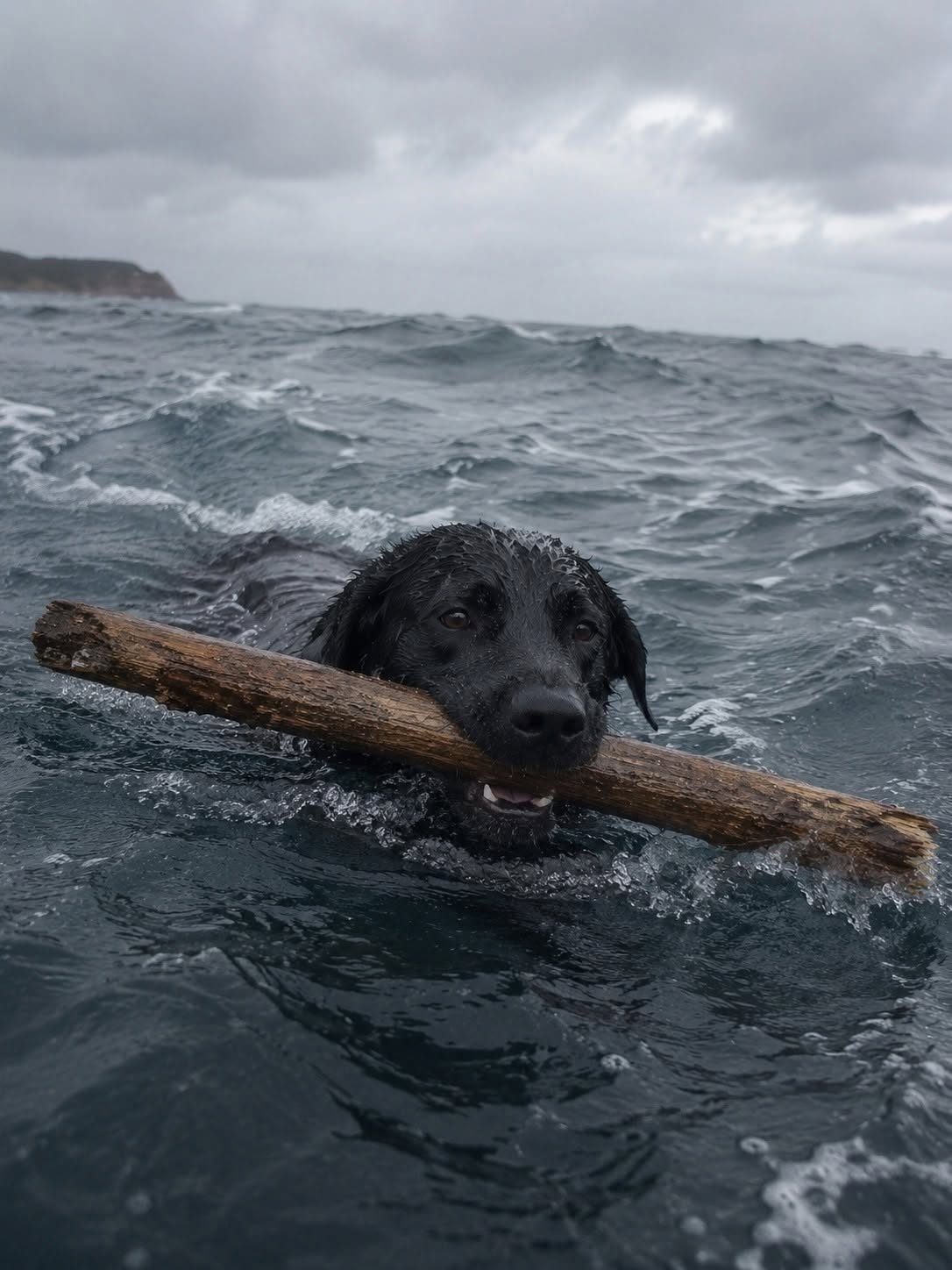
It was a black Labrador. About 50 pounds. Soaked fur plastered to its body, barely afloat. It wasn’t swimming anymore—it was clinging to a broken dock plank a little over a meter long. Not resting on it. Clinging on. Its jaws were clamped around the wood so tightly that its teeth were sunk into the plank. One front leg caught. The rest of its body dragging in the icy water.
Eyes open. Distant. Body trembling in continuous spasms.
Marcos maneuvered the boat carefully. When he bent down to lift her, he discovered that he physically couldn’t release the wood—her jaw muscles had completely locked. Instead of forcing it and risking breaking her jaw, he used a saw to cut the board and pulled her aboard with the piece of wood still lodged between her teeth.
The Labrador barely reacted. She simply continued biting.
That afternoon, the port’s security cameras showed what had happened. At 9:41 the previous night, a pleasure craft stopped several kilometers offshore. Two people threw a dark, wriggling object into the water.
That object was her.
The water temperature that night: eleven degrees. I had drifted almost ten kilometers.
At the clinic, even under sedation, the dog still wouldn’t let go of the wood. It took Dr. Elena Vidal almost four minutes after sedation to pry the teeth free from the board. They found several cracked teeth, deep lacerations in the gums, and more than twenty splinters embedded in the paws. The dog was suffering from severe hypothermia, kidney damage, pulmonary complications from near-drowning, and nerve damage in both hind legs.
One never fully recovered. She still limps when the temperature drops.
“Her body believed that letting go meant death,” Dr. Vidal explained. “I’ve never seen an animal overcome survival fatigue like that. She decided she wasn’t going to die.”
The recovery took two months. Marcos visited her every day—every morning before leaving, every afternoon upon returning. He would sit by her cage, speaking softly to her as she rested her injured head on his boot. He had never owned a dog before. By the fourth week, everyone at the clinic knew she belonged to him.
She called it Madera.
“Because that piece of wood kept her alive,” she said simply. “Everyone else threw her away. But something broken floating in the darkness gave her a chance, and she clung to it.”
Madera is about six years old today. Several of his teeth are still chipped. He drags his hind leg when he gets tired. He doesn’t go near the water. He has never been on Marcos’s boat.
Every afternoon he waits by the window overlooking the port.
And when Marcos arrives smelling of salt and diesel — Madera walks towards him, climbs onto his lap and gently grabs the sleeve of his jacket with his mouth.
No biting. No playing. Holding on.
Just like he clung to that board for eleven hours.
Marcos never leaves. Sometimes they stay like that for almost an hour, both of them looking at the Atlantic through the window.
A colleague asked him why he lets her do it every night.
Marcos looked at the dog sleeping next to his chair.
— Some people talk about the will to live as if it were just an expression. I pulled them out of the ocean with my own hands. She clung on for eleven hours because she believed that if she let go for even a second, she would disappear.
He paused.
— So if you still need to hold on to something safe…
She smiled.
— He’s earned it.
Do you think animals understand something about love and loyalty that humans sometimes forget?
If this story touched you — le