The morning began like countless others. A cool breeze drifted in from the Atlantic Ocean, carrying the familiar scent of saltwater as I walked along the shoreline with my dog. The waves rolled in gently, and the beach was nearly empty—a peaceful start to what I expected would be an ordinary day.
Then everything changed.
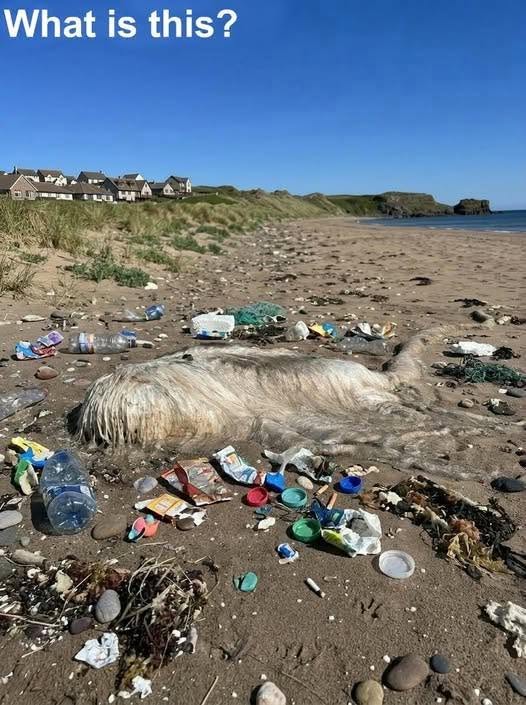
A few yards ahead, something unusual caught my eye. At first, I couldn’t tell what I was looking at. It appeared to be a pale, tangled mass lying motionless on the sand. The strange object glistened in the morning light, its translucent strands spread across the beach like wet silver hair.
My dog noticed it too. Suddenly, he pulled hard on the leash, ears forward, nose twitching, eager to investigate.
I froze. Something about the sight immediately felt wrong.
What I was looking at didn’t resemble anything I’d ever seen before. And what happened next would completely change how I view beach walks—and the ocean itself.
🌊 The Mysterious Object on the Shore
As I cautiously moved closer, the details became even more unsettling.
The object was enormous. Its body appeared gelatinous and semi-transparent, almost glowing beneath the weak sunlight. Long, tangled strands stretched across the sand in every direction, some partially buried, others drifting slightly with the shifting tide.
For a brief moment, my imagination took over.
Was it some kind of deep-sea creature?
A rare marine animal?
Or something far stranger?
Was it some kind of deep-sea creature?
A rare marine animal?
Or something far stranger?
Every instinct told me to turn around and leave. Instead, curiosity rooted me in place. I tightened my grip on the leash, carefully snapped a few photos from a safe distance, and backed away slowly.
The more I looked at it, the less it seemed to belong on the beach. It felt like something that had surfaced from the darkest depths of the ocean.
🔍 Searching for Answers: What Was It?
Back at home, I couldn’t stop thinking about what I’d seen. I shared the photos with friends and family. The responses ranged from confusion to alarm.
- Some thought it might be an unusual species of jellyfish.
- Others guessed it was marine debris or a washed-up seaweed colony.
- A few joked that it looked like an alien life form.
But nobody could identify it with certainty.
Determined to find an answer, I spent hours researching marine biology websites, wildlife databases, and ocean conservation forums. I compared tentacle patterns, bell shapes, and stranding behaviors. I cross-referenced regional species guides.
Then I finally found a match.
And the truth was even more shocking than I expected.
🪼 The Creature’s Real Identity: The Lion’s Mane Jellyfish
The mysterious object wasn’t an alien. It wasn’t a sea monster.
It was a Lion’s Mane Jellyfish (Cyanea capillata), one of the largest and most visually striking jellyfish species on Earth.
Key Facts About the Lion’s Mane:
|
Feature
|
Details
|
|---|---|
|
Bell size
|
Up to 6–7 feet (2 meters) in diameter
|
|
Tentacle length
|
Can exceed 100 feet (37 meters)—longer than a blue whale
|
|
Habitat
|
Cold, boreal waters of the North Atlantic and Pacific
|
|
Appearance
|
Massive translucent bell with dense, hair-like tentacles (hence the name)
|
|
Diet
|
Zooplankton, small fish, fish eggs, and other tiny marine organisms
|
|
Lifespan
|
Typically less than 1 year, but blooms can appear seasonally
|
They commonly wash ashore after strong winds, shifting tides, or summer storms. When stranded, they lose their graceful floating shape and collapse into pale, tangled masses that look nothing like the living creature gliding through open water.
⚠️ The Hidden Danger: Why “Dead” Jellyfish Are Still a Threat
What frightened me most wasn’t the jellyfish itself. It was what I learned next.
Even after washing ashore, a Lion’s Mane Jellyfish can remain dangerous.
Its tentacles contain thousands of specialized stinging cells called nematocysts. These microscopic harpoons remain armed and can fire on contact long after the jellyfish has died or washed up.
Why This Matters for Beachgoers & Pet Owners:
|
Risk
|
Explanation
|
|---|---|
|
Painful stings
|
Nematocysts inject venom into skin, causing burning, redness, swelling, and welts
|
|
Delayed reactions
|
Stings can worsen over hours; allergic responses are possible
|
|
Pets at higher risk
|
Dogs can step on invisible tentacles, get stung on paws/muzzles, or ingest venom by licking
|
|
Invisible threat
|
Stranded tentacles often blend into wet sand or seaweed, making them easy to miss
|
Many people assume stranded jellyfish are harmless. That assumption is dangerously wrong.
Marine experts and veterinary professionals strongly warn: Never touch a jellyfish on the beach, even if it looks completely lifeless.
🐾 What to Do If You or Your Pet Encounters One
Prevention is the best defense. But if an encounter happens, knowing how to respond can prevent serious injury.
✅ Do This:
|
Situation
|
Action
|
|---|---|
|
Spotting a jellyfish on shore
|
Keep distance. Keep pets leashed. Mark the area if others might walk by.
|
|
Human sting
|
Rinse with seawater (not freshwater). Carefully remove tentacles with tweezers or a gloved hand. Apply hot water (110°F/43°C) for 20–45 mins to relieve pain. Seek medical care if stings are widespread or if breathing/swallowing is affected.
|
|
Dog contact/sting
|
Prevent licking. Rinse paws/muzzle with seawater. Do not use vinegar unless confirmed safe for the species in your region. Contact your vet immediately—dogs are more vulnerable to systemic reactions.
|
|
Removing stranded jellyfish
|
Use a shovel or thick gloves. Place in a sealed bag. Do not handle with bare hands.
|
❌ Avoid These Common Mistakes:
- Rinsing with freshwater or urine: Triggers remaining nematocysts to fire, worsening the sting.
- Rubbing the area: Spreads venom and embeds stinging cells deeper.
- Applying ice directly: Can worsen tissue damage; heat is more effective for jellyfish venom.
- Letting pets sniff or lick: Ingestion or mucous membrane contact can cause severe reactions.
🌊 Pro tip: Carry a small beach safety kit: seawater rinse bottle, tweezers, disposable gloves, and your vet/urgent care number. Prevention takes seconds; treatment takes time.
🌍 Why Lion’s Mane Jellyfish Matter to the Ocean
Despite their intimidating appearance, Lion’s Mane Jellyfish play a vital role in marine ecosystems.
Ecological Importance:
|
Role
|
Impact
|
|---|---|
|
Population control
|
Feed on zooplankton, fish larvae, and small invertebrates, helping maintain balance
|
|
Food source
|
Sunfish, leatherback turtles, certain seabirds, and even some whale species feed on them
|
|
Ocean health indicators
|
Blooms can signal changes in water temperature, nutrient levels, or prey availability
|
|
Carbon cycle participants
|
When they die and sink, they transport nutrients to deep-sea ecosystems
|
Climate change and warming coastal waters are altering jellyfish bloom patterns. While some species thrive in changing conditions, others face habitat loss. Understanding them helps scientists track ocean health and predict ecological shifts.
❓ Frequently Asked Questions
Q: Can a Lion’s Mane jellyfish kill a dog?
A: Fatalities are extremely rare, but dogs are more vulnerable due to fur trapping tentacles, smaller body mass, and tendency to lick stings. Severe reactions can cause swelling, breathing difficulty, or shock. Always seek veterinary care after contact.
A: Fatalities are extremely rare, but dogs are more vulnerable due to fur trapping tentacles, smaller body mass, and tendency to lick stings. Severe reactions can cause swelling, breathing difficulty, or shock. Always seek veterinary care after contact.
Q: How can I tell if a washed-up jellyfish is still dangerous?
A: Assume all jellyfish on the beach are capable of stinging. Nematocysts can remain active for days after stranding. Never assume appearance indicates safety.
A: Assume all jellyfish on the beach are capable of stinging. Nematocysts can remain active for days after stranding. Never assume appearance indicates safety.
Q: Why do they wash ashore so often?
A: Onshore winds, tidal shifts, storms, and seasonal currents push them into shallow water. Once stranded, they cannot swim back out and dehydrate quickly.
A: Onshore winds, tidal shifts, storms, and seasonal currents push them into shallow water. Once stranded, they cannot swim back out and dehydrate quickly.
Q: Are Lion’s Mane jellyfish common?
A: Yes, in cold northern waters. They peak in late summer and early fall. Sightings increase after storms or prolonged onshore winds.
A: Yes, in cold northern waters. They peak in late summer and early fall. Sightings increase after storms or prolonged onshore winds.
Q: What’s the difference between a Lion’s Mane and a Portuguese Man o’ War?
A: Lion’s Mane are true jellyfish (scyphozoans) with a bell and tentacles. Portuguese Man o’ War are siphonophores (colonial organisms) with a gas-filled float and long, blue tentacles. Both sting, but Man o’ War venom is generally more potent.
A: Lion’s Mane are true jellyfish (scyphozoans) with a bell and tentacles. Portuguese Man o’ War are siphonophores (colonial organisms) with a gas-filled float and long, blue tentacles. Both sting, but Man o’ War venom is generally more potent.
Q: How long do jellyfish stings last?
A: Skin redness and welts typically fade in 1–2 weeks. Pain usually subsides within hours with proper treatment. Itching or mild scarring can persist longer.
A: Skin redness and welts typically fade in 1–2 weeks. Pain usually subsides within hours with proper treatment. Itching or mild scarring can persist longer.
Q: Can I walk my dog safely during jellyfish season?
A: Yes. Keep your dog on a leash, stick to cleared paths, avoid drifting debris or wet sand near the tide line, and check paws frequently after beach walks.
A: Yes. Keep your dog on a leash, stick to cleared paths, avoid drifting debris or wet sand near the tide line, and check paws frequently after beach walks.
💙 A Compassionate Closing Thought
If you’re reading this because you’ve seen something strange on the shore, or because you simply want to protect yourself and your pet during beach walks—please know:
🌊 Wonder and caution can coexist. The ocean is breathtaking, but it demands respect. That doesn’t mean fear—it means awareness.
🌊 Curiosity saved me. Pausing, researching, and learning turned a startling moment into valuable knowledge. You can do the same.
🌊 Nature isn’t out to get us. Jellyfish don’t wash ashore to cause harm. They’re following currents, winds, and ancient rhythms. Understanding them helps us share the shoreline safely.
🌊 Your dog’s instincts are a gift. That pull on the leash? It’s curiosity. Your restraint? It’s protection. Together, they keep you both safe.
🌊 Curiosity saved me. Pausing, researching, and learning turned a startling moment into valuable knowledge. You can do the same.
🌊 Nature isn’t out to get us. Jellyfish don’t wash ashore to cause harm. They’re following currents, winds, and ancient rhythms. Understanding them helps us share the shoreline safely.
🌊 Your dog’s instincts are a gift. That pull on the leash? It’s curiosity. Your restraint? It’s protection. Together, they keep you both safe.
Standing on that beach, I was reminded of how little we truly know about the world beneath the waves. But I was also reminded of how much we can learn when we pause, observe, and choose wisdom over assumption.
The next time you walk the shoreline, may you feel the same wonder I did that morning. And may you also carry the quiet confidence that comes from knowing how to stay safe, how to protect those who depend on you, and how to respect the wild, beautiful creatures that share our coasts.
🧭 The Bottom Line
A mysterious beach encounter turned into a valuable lesson about marine biology, pet safety, and ocean respect.
Remember: 🪼 Lion’s Mane Jellyfish are large, beautiful, and naturally harmless unless touched
⚠️ Stinging cells remain active long after stranding—never handle washed-up jellyfish
🐾 Keep pets leashed near tide lines; rinse immediately if contact occurs
🌊 Seawater rinse + heat + professional care = best sting response
💙 Awareness doesn’t ruin beach days—it protects them
⚠️ Stinging cells remain active long after stranding—never handle washed-up jellyfish
🐾 Keep pets leashed near tide lines; rinse immediately if contact occurs
🌊 Seawater rinse + heat + professional care = best sting response
💙 Awareness doesn’t ruin beach days—it protects them
You don’t need to fear the ocean to respect it. And you don’t need to touch something strange to understand its place in the world.
Stay curious. Stay cautious. And keep walking that shoreline—with wonder, wisdom, and a safe distance between you and the deep.
Have you ever encountered a jellyfish or other unusual marine life on the beach? How did you handle it? Share your experiences and safety tips respectfully in the comments below. 🌊🐾