Why Dogs Sniff People This Way — What It Actually Means
Share this post with friends!

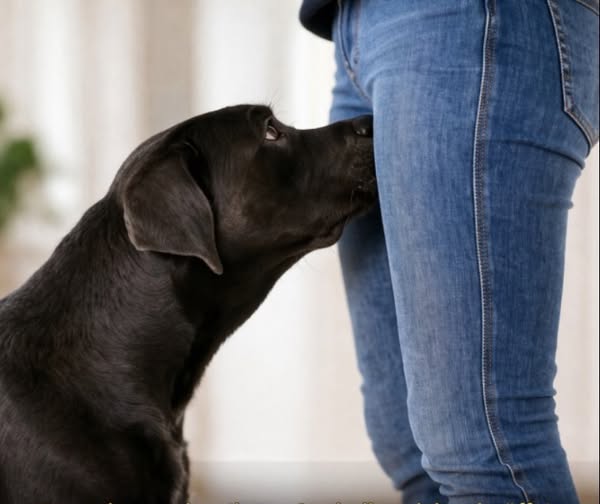
One of the more awkward situations many pet owners experience happens when a dog suddenly approaches a person and begins investigating very personal areas.
While this can feel uncomfortable, especially in social environments, it is important to understand that this behavior is not random or inappropriate from the dog’s perspective.
Dogs experience the world primarily through their sense of smell.
Unlike humans, who rely heavily on sight and verbal communication, dogs use scent as their main source of information.
Their noses are capable of detecting subtle chemical signals that humans are not even aware exist.
When a dog approaches a person, it is essentially gathering information.
This process allows the dog to understand who the person is, how they are feeling, and whether they are familiar or new.
It is a natural part of how dogs interpret their environment.
Certain areas of the human body carry stronger scent signals.
These areas provide more detailed information, making them especially interesting to dogs.
Because of their height and natural instincts, dogs often investigate these areas first.
Although this behavior may feel socially uncomfortable, it is not driven by intention to embarrass or disrupt.
It is simply the dog following its instincts and using its strongest sense to understand the situation.Tap the p.hoto to c.ontin.ue rea.ding the ar.ticle.

Dogs possess an extraordinary ability to detect changes in scent.
They can notice subtle variations related to stress, mood, or even physical changes in the body.
This sensitivity is one of the reasons dogs are often trained for specialized roles, such as assisting in medical detection or search and rescue operations.
In everyday life, however, this ability is simply part of how they interact with people.
When a dog shows increased interest in a specific person, it may be responding to unfamiliar or stronger scent signals.
This does not indicate anything negative—it is simply curiosity combined with instinct.
From a dog’s perspective, this behavior is similar to how humans greet each other.
While people rely on eye contact, conversation, or gestures, dogs rely on scent-based communication.
This method allows them to quickly gather a wide range of information in a short amount of time.
Social situations can make this behavior more noticeable.
When guests are present, dogs are often more curious because they are encountering new scents.
This can lead to more direct and sometimes awkward interactions.
Understanding this difference in communication styles can help reduce frustration.
Instead of seeing the behavior as problematic, it becomes easier to recognize it as a natural part of canine behavior.Tap the p.hoto to c.ontin.ue rea.ding the ar.ticle.

While this instinct is completely natural, it can still be guided to better fit social environments.
Training plays an important role in helping dogs learn alternative ways to greet people.
Simple commands such as “sit,” “stay,” or “come” can redirect attention and create a more comfortable interaction.
Positive reinforcement is the most effective approach.
Rewarding a dog for calm and appropriate behavior helps reinforce those actions over time.
Consistency is key, as mixed signals can confuse the dog and make learning more difficult.
It is also important to remember that dogs do not share human concepts of personal space.
Their behavior is not meant to challenge boundaries but to explore and understand.
Recognizing this can shift the perspective from embarrassment to awareness.
Over time, with proper guidance, dogs can learn to balance their natural instincts with socially acceptable behavior.
This allows them to interact comfortably with people while still relying on their senses in a more controlled way.
In the end, this behavior highlights the difference between human and canine communication.
What feels unusual to us is completely normal for them.
By understanding the reason behind it, pet owners can respond more calmly and effectively.
Rather than viewing it as a problem, it can be seen as an opportunity to better understand how dogs experience the world—and how we can guide that behavior in a positive direction.

0 thoughts

Leave a Reply